Australian values for the citizenship test
Five of the 20 test questions are about Australian values, and you must get all five right to pass. Here's what they cover.
This summary follows Part 4 of Our Common Bond, "Australian Values", as it appears in the app. It is a study aid; the handbook on the Home Affairs website is the authoritative version.
The Rule of Law and Parliamentary Democracy
All Australians are protected by, and equal under, the law — no person or group is above it, and everyone should obey it even when no one is watching. Australian law applies to everyone in Australia regardless of background or culture. Australia's system of government is a parliamentary democracy: laws are determined by parliaments elected by the people, so citizens are directly involved in how the country is governed, and voting is compulsory as a mark of the importance of participating in elections.
Freedom of Speech and Association
People in Australia are free to express their ideas, meet for social or political discussion, and peacefully protest government actions, so long as it is within the law — peaceful public protest is considered an essential part of democracy. It is never acceptable, however, to promote violence against a person or group, make false allegations, or encourage others to break the law. Freedom of association lets people freely join or leave any legal group — a political party, union, or religious, cultural or social group — without being compelled to join or forced to leave, provided any gathering remains peaceful and lawful.
Freedom of Religion
Australia has no official national religion, and the government treats all citizens equally regardless of their religion or beliefs. People are free to follow any religion they choose. Religious laws have no legal status in Australia — everyone must follow Australian law, including where it differs from religious law — and practices such as polygamy and forced marriage are against the law and can carry severe penalties, including imprisonment. Religious intolerance is not acceptable in Australian society.
Equality Under the Law
Australian society values equal rights regardless of gender, sexual orientation, age, disability, religion, race, or national or ethnic origin, and laws exist to prevent people being treated differently because of these things. Men and women have equal rights and equal access to education, employment, voting, standing for parliament, and service in the Defence Force and police. Two people of any gender combination can marry. Physical violence against a spouse or partner is a criminal offence, and either spouse may apply for divorce even if the other objects. Equality of opportunity — a 'fair go' — means success should come from a person's hard work and talent rather than their gender, wealth or ethnicity.
Mutual Respect and Tolerance
Australians are expected to respect the freedom, dignity, opinions and choices of others, and violence of any kind — verbal or physical — is illegal. The legal age of sexual consent is 16 or 17 depending on the state or territory, and it is strictly enforced. Lawful requests from police should be obeyed. Mutual respect and tolerance mean listening to and respecting others' views even when they differ from your own; racism, including online, has no place in Australia and should be reported.
Community, Contribution and Loyalty
Citizenship means participating in and contributing to the community — through work, volunteering, or supporting others in the spirit of 'mateship', such as helping a neighbour or checking on someone who is unwell. English is Australia's national language and an important part of social and economic participation, and citizenship applicants must make reasonable efforts to learn it if it is not their native language. Citizens are also expected to help keep society safe, for example by reporting suspected serious crime or child abuse to authorities. Citizens may hold dual or multiple citizenship, but must obey Australian law at all times within Australia, and some Australian laws — such as those against child sexual abuse — apply to citizens even while overseas.
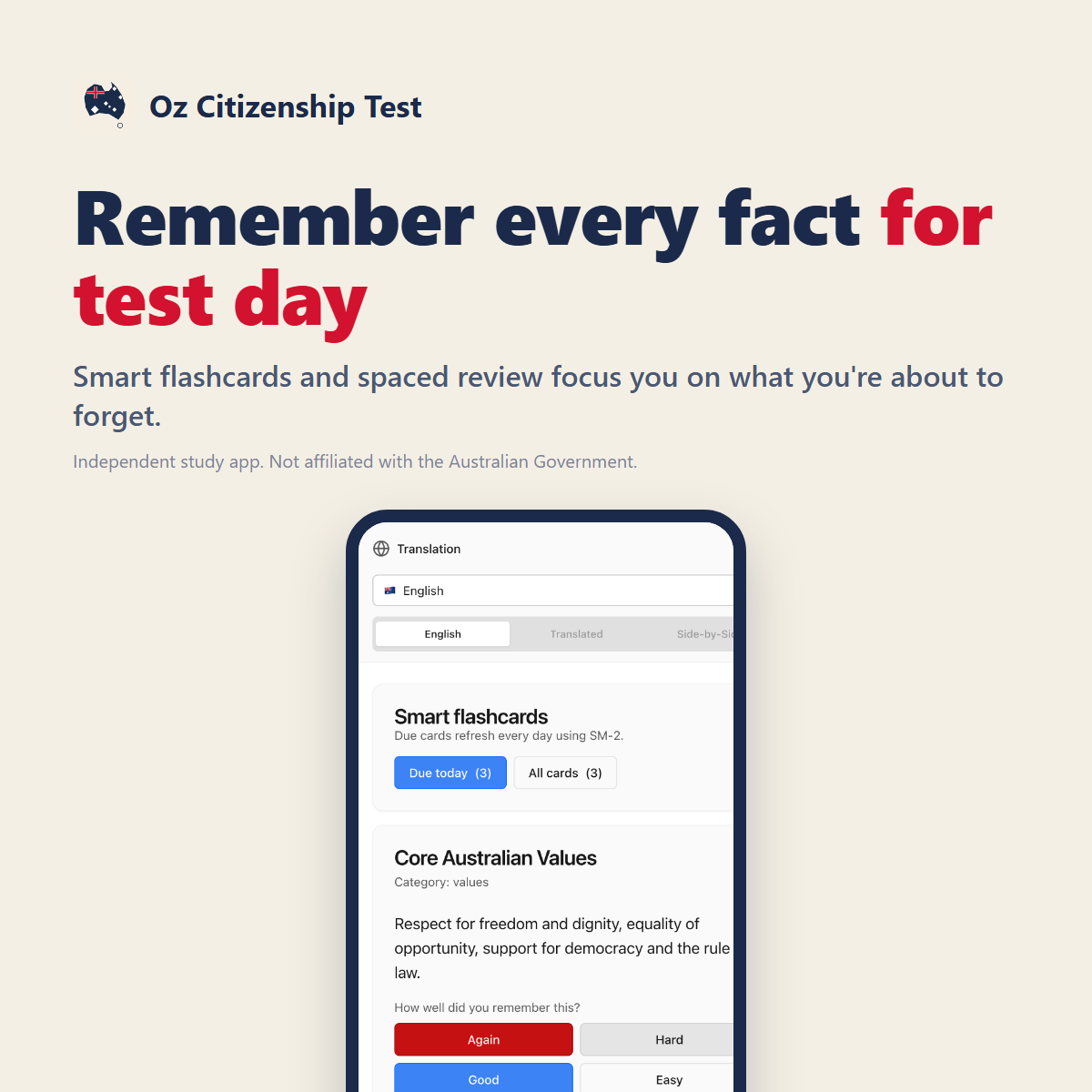
Practice questions on Australian values
- Which value describes the Australian spirit?
A spirit of egalitarianism embracing mutual respect and tolerance. Australia values a spirit of egalitarianism that embraces mutual respect, tolerance, fair play, and compassion for those in need. - Freedom of religion in Australia means:
People are free to follow any religion or no religion. Freedom of religion in Australia means people are free to follow any religion they choose, or no religion at all, without discrimination. - What does 'rule of law' mean in Australia?
Laws apply equally to everyone, including government officials. The rule of law means that laws apply equally to everyone in Australia, including government officials. No one is above the law. - Which statement about equality reflects Australian values?
Everyone has equal rights regardless of gender. In Australia, men and women have equal rights and are treated equally under the law, reflecting the value of equality for all. - What does mutual respect mean in Australian society?
Treating others with consideration and dignity. Mutual respect means treating all people with consideration and dignity, even if you disagree with them.
Five more values questions are in the free practice test.

Start studying tonight
Read the whole Our Common Bond handbook free, in English and 12 other languages. Unlock the practice tests and flashcards with one purchase.